THE THRESHOLD

DEATH : A skeletal figure in black armour rides a white horse through a landscape where people of all ages and stations kneel or fall before them. A bishop, a child, a maiden, and a fallen figure illustrate that death comes for everyone regardless of status. Transformation is universal and inevitable. The white rose on the black banner represents the purity of renewal that follows endings, beauty emerging from apparent destruction. The rising sun between two towers in the background symbolises that something new always follows what has passed. The river flowing through the scene represents the constant movement of life. The white horse represents purity of purpose. Death doesn’t discriminate or negotiate.
Death promotes life by clearing away what is old, worn out and ready to be disposed of, so something new and better can take its place. This is the energy of endings that make room for beginnings. Death represents the necessary conclusion of something, a relationship, a belief, an identity, a way of life, so that something new can emerge. It's not punishment. It's the natural cycle of things dying so other things can be born. Fighting it usually causes more suffering than surrendering to it.

Zdzisław Beksiński - untitled (ca. 1971)
Ancient thresholds, modern gateways
By Mark Gresham
“ In the world of ancient Rome, a portal was never simply an opening in a wall. It was a threshold, a deliberate act of architecture meant to mark transition and meaning. Arches, gates, and doorways shaped the civic and spiritual lives of communities. Passing through them often signified movement from one realm to another—into the forum, the temple, or the arena. Even the gods had their guardians of passage: Janus, two-faced, looking both forward and back, presided over beginnings, endings, and thresholds alike. For the Greeks before them, doorways bore similar weight. The act of crossing a threshold was at once physical and symbolic: stepping into a place of gathering, commerce, performance, or worship. Such portals signified the joining of people and ideas, the exchange of art and story, and the emergence of identity rooted in place. Portals, in other words, are more than structures. They are invitations."

Pierre Amedée Marcel-Beronneau - Orpheus in Hades (1897)
“ The story of Orpheus, it occurs to me, is not just about the desire of the living to resuscitate the dead but about the ways in which the dead drag us along into their shadowy realm because we cannot let them go. So we follow them into the Underworld, descending, descending, until one day we turn and make our way back.”
― Meghan O'Rourke
.jpg)
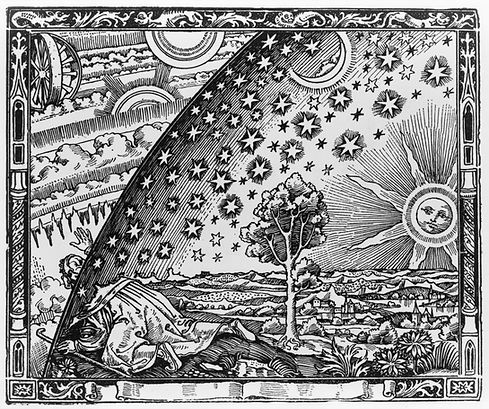
The Flammarion engraving is a wood engraving by an unknown artist that first appeared in Camille Flammarion's L'Atmosphère: Météorologie populaire (1888). The image depicts a man crawling under the edge of the sky, depicted as if it were a solid hemisphere, to look at the mysterious Empyrean beyond. The caption underneath the engraving (not shown here) translates to “A medieval missionary tells that he has found the point where heaven and Earth meet..."
Threshold, Liminality, and the Way of the Mystic
By Christine Valters Paintner
The mystic lives at the juncture between heaven and earth and lifts up all the ways they see the world behind the world breaking through. The visionary is inspired by images that appear like dreams to instruct and inspire about how we are to live fully in loving relationship with the divine presence.
In Dr. Terrill Gibson’s The Liminal and the Luminescent, he describes the power and necessity of making ourselves available to this liminal realm: The liminal is “where our Destiny—both collective and individual—is revealed. Many believe that this in-between liminal realm, this vast, ripe, emptiness within our understandings of conventional time and space, is where our primal wound is healed [...] So, it is necessary to find the doorway, the portal, into such depth chambers of the
psyche in order for such repeated, transformative exposure to occur. It is through this portal that the depth psycho-spiritual journey begins.” He goes on to describe the liminal as “an evanescent, translucent place between worlds.” This is the realm that the mystics regularly encounter and spend time. It is the place where we draw our inspiration, renewal, and healing. Rather than imagine the liminal as a space up in heaven, we might see it as a deep well within that we can draw upon through dreams and intuition. The portal to these healing waters is everywhere. All that is required is an opening of our eyes and our hearts, a quiet presence and attunement. We enter this liminal space in many ways – dreams, pilgrimage, through landscape and nature, ritual, and the creative arts are all doorways.

Want the Change.
Be inspired by the flame
Where everything shines as it disappears.
The artist, when sketching, loves nothing so much
as the curve of the body as it turns away.
What locks itself in sameness has congealed.
Is it safer to be gray and numb?
What turns hard becomes rigid
and is easily shattered.
Pour yourself like a fountain.
Flow into the knowledge that what you are seeking
finishes often at the start, and, with ending, begins.
Every happiness is the child of a separation
it did not think it could survive. And Daphne, becoming a laurel, dares you to become the wind.
Rainer Maria Rilke, Sonnets to Orpheus (1922)
“ A vie. A mort. Et après...
A l'infini des temps
et de la matière palpable
et impalpable...
Et du Néant. "
― Christian Vander
CREDITS
The Threshold original fuzz bass improvisation recorded on October 28th, 2019. Originally released on Last Incantations (2019). Remixed in 2025 by Sébastien Dumontier, mastered by Laurent Roussel.
Electric & ambient guitars, electric sitar, bass guitars, percussions & drum programming, synth theremin, piano & Mellotron played by Finrod Artîwelë.