

MORNING RAGA
-
“ The raga is more fixed than mode, less fixed than the melody, beyond the mode and short of melody, and richer both than a given mode or a given melody; it is mode with added multiple specialities"
― José Luiz Martinez

ACE OF PENTACLES : Floating in a clear sky, inside a garland of roses and lilies, is a disc woven from grass and aged to a golden patina. There is a warm light that emanates from this medallion, of something pulled from the dark and brought to light, moving upwards in joy. The Ace of Pentacles is the harbinger of beginnings, full of shapes, figures, objects, ideas, and movement. It is a time ripe with hope made manifest. This is the very beginning of something tangible, the first step towards building something real. The question is whether you'll nurture it.
RAGAS AND THEIR SYMBOLISM
Indian classical music has ancient roots and developed to serve both spiritual and entertainment purposes. Conceptions of sound can be traced back to the Vedic period. Sound is thought to carry a metaphysical power, thus the memorisation of Vedic texts also required precise intonation.
Most Hindus do not regard music as merely entertainment but as a spiritual practice and path to moksha (liberation). In this tradition, ragas are believed to have an inherent natural existence that is discovered rather than invented by artists. Music resonates with human beings because it reflects the hidden harmonies of the ultimate creation. Ancient texts such as the Sama Veda (~1000 BCE), which also arranges the Rigveda to melodic patterns, are entirely structured according to melodic themes. The ragas were envisioned by the Hindus as a manifestation of the divine, with each musical note treated as a god or goddess with complex personality.
The symbolic role of classical music through raga has been both aesthetic indulgence and the spiritual purifying of one's mind (yoga). The former is encouraged in Kama literature (such as Kamasutra), while the latter appears in Yoga literature with concepts such as Nada-Brahman (metaphysical Brahman of sound, also meaning “the world is sound”). This belief resonates deeply with the idea that sound is the essence of creation. Every vibration, every sound wave, is an expression of the divine. Through these vibrations, we connect to the infinite energy of the universe. The concept of Nada Brahma takes us beyond mere auditory experience; it invites us to explore the vibrational nature of life itself, where every being, every thought, and every emotion is a frequency in the grand symphony of existence.

George Chinnery - Ruins of a Temple, Sunset
A raga is not a tune, because the same raga can yield an infinite number of tunes. A raga is not a scale, because many ragas can be based on the same scale. A raga is a fusion of technical and ideational ideas found in music, and may be roughly described as a musical entity that includes note intonation, relative duration and order, in a manner similar to how words flexibly form phrases to create an atmosphere of expression. In some cases, certain rules are considered obligatory, in others optional. The raga allows flexibility, where the artist may rely on simple expression, or may add ornamentations yet express the same essential message but evoke a different intensity of mood.
The North Indian raga system (called Hindustani) suggests a particular time of a day or a season, in the belief that the human state of psyche and mind are affected by the seasons and by daily biological cycles and nature's rhythms. Pure and simple ragas are associated to early morning, mixed and more complex ragas to late morning, skillful ragas to noon, love-themed and passionate ragas to evening, and universal ragas to night.

George Chinnery - Indian Temple (ca. 1808-12)
In the Yoga Sutras (a compilation from a variety of sources of Sanskrit sutras or aphorisms on the practice of yoga) n°II.7, rāga is defined as the desire for pleasure based on remembering past experiences of pleasure. Memory triggers the wish to repeat those experiences, leading to attachment. Ego is seen as the root of this attachment, and memory is necessary for attachment to form. Even when not consciously remembered, past impressions can unconsciously draw the mind toward objects of pleasure.
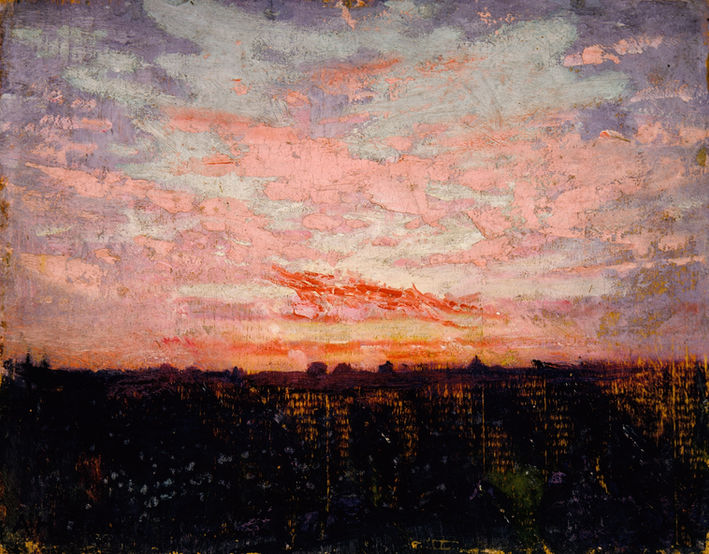
Abbott Handerson Thayer - Sunrise Or Sunset, Study For Book, Concealing Coloration In The Animal Kingdom (ca. 1905-1909)
CREDITS
Morning Rāga originally recorded on May 19th, 2018. First released on Raag Against The Machines (2018). Remixed in 2025 by Sébastien Dumontier, mastered by Laurent Roussel.
Acoustic & E-bow guitars, keyboards & percussions played by Finrod Artîwelë. Drums played by Lavinia Roussel.