

FOLLOW THE RIVER
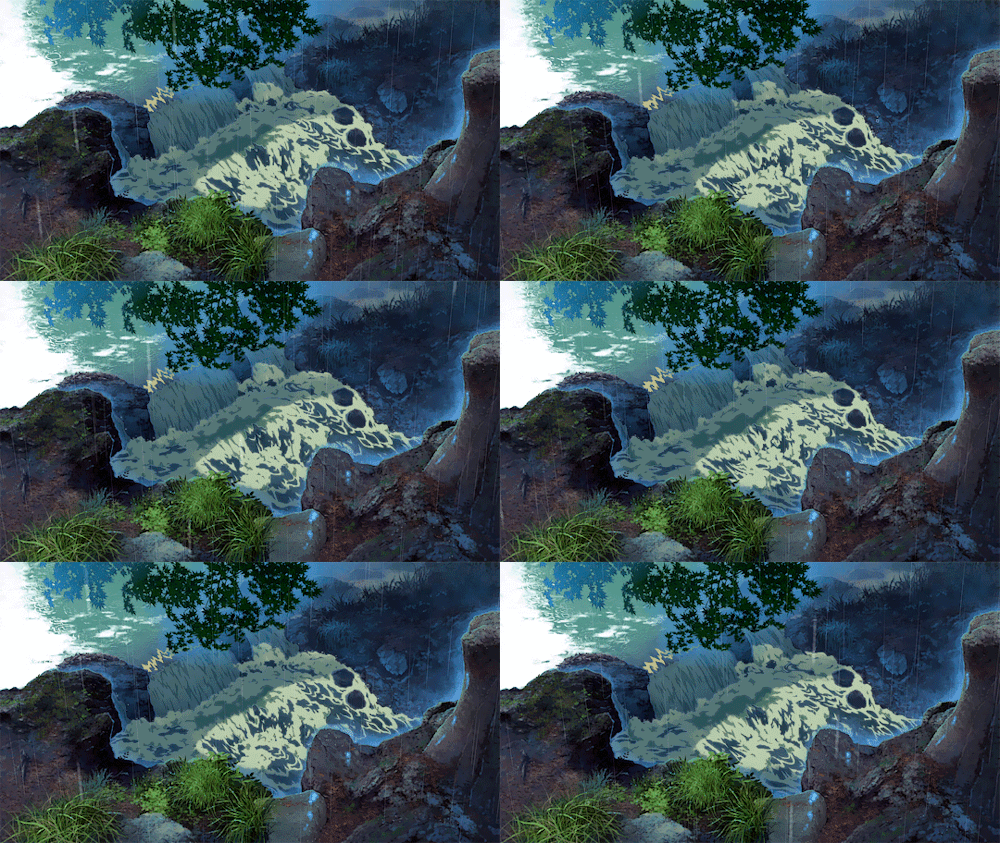
“Moving down the water, John is drifting out of sight. Its only at the turning point that you find out how you fight. In the cold, feel the cold all around, and the rush of crashing water surrounds me with its sound. Striking out to reach you I can't get through to the other side, when you're racing in the rapids there's only one way, that's to ride.
Taken down, taken down by the undertow, I'm spiraled down the river bed, my fire is burning low. Catching hold of a rock that's firm, I'm waiting for John to be carried past. We hold together, hold together and shoot the rapids fast. And when the waters slow down, the dark and the deep have no-one left to keep. Hang on John! We're out of this at last. But somethings changed, that's not your face. It's mine - it's mine!"
― Peter Gabriel/Genesis,
In The Rapids from The Lamb Lies Down On Broadway (1974)

Thomas Cole - The Voyage Of Life: Manhood (1842)
WASHING AWAY THE MUD:
On the Albedo of the Alchemical Opus
by Jason Smith
“The operations of the alchemical opus are often divided into four stages: nigredo, albedo, citrinitas, and rubedo. The nigredo is the initial state, the “muddy” conditions that prevail at the beginning of the opus. Following the chaos or massa confusa of the nigredo stage, the alchemist undertakes a purification in albedo, the first great work of the whole process, which is literally referred to as ablutio – the washing away of impurities. This phase is concerned with “bringing light and clarity to the prima materia". In many ways, this is the heart and soul of the entire opus and involves, we are told, the greatest efforts on the part of the alchemist. In Alchemy: An Introduction to the Symbolism and the Psychology, Marie-Louise von Franz describes it this way: “In the alchemical literature it is generally said that the great effort and trouble continues from the nigredo to the albedo; that is said to be the hard part, and afterwards everything becomes easier. The nigredo — the blackness, the terrible depression and state of dissolution — has to be compensated by the hard work of the alchemist and that hard work consists, among other things, in constant washing."
In this process, the subject is divided into two opposing principles to be later coagulated to form a unity of opposites or coincidentia oppositorum during rubedo. Alchemists also applied it to an individual's soul after the first phase is completed, which entailed the decay of matter. In Medieval literature, which developed an intricate system of images and symbols for alchemy, the dove often represented this stage, while the raven symbolized nigredo. Titus Burckhardt interprets the albedo as the end of the lesser work, corresponding to a spiritualization of the body, and claims that the goal of this portion of the process is to regain the original purity and receptivity of the soul.

John Everett Millais - Ophelia (1851)
[...] The decisive factor seems to be the water in which one washes. [...] Matter is to be washed in the aqua divina, the divine water, which already contains some qualities of the Philosophers’ Stone. This water, Jung writes, can be compared to the waters of baptism:
“Altogether, the divine water possessed the power of transformation. It transformed the nigredo into the albedo through the miraculous ‘washing’ (ablutio); it animated inert matter, made the dead to rise again, and therefore possessed the virtue of the baptismal water in the ecclesiastical rite."- C.G. Jung, Alchemical Studies, CW 13, par. 89

Malene Reynolds Laugesen - Dreaming Hills (2013)

VIII OF Wands : The Eight of Wands encourages you to go with the flow. Everything's moving at once and you can't slow it down. Messages flying, events cascading, momentum building faster than you can track. The Eight of Wands is speed, urgency, things happening whether you're ready or not. You can try to control it, but you'd be better off holding on and paying attention. There is a great sense of purpose approaching, a goal or dream about to be realised, and The Seeker will need to be swift and strong - but at the same time manage to keep that force from becoming too aggressive, so that all is not spent in one furious moment.
There are no human figures in this card, only motion. The absence of people emphasises that this energy moves independently of human control. The clear sky means nothing’s blocking the path. The parallel trajectory shows alignment, everything heading the same way at the same pace. The river below mirrors the wands’ movement, flowing in the same direction. The green landscape suggests the conditions are fertile for whatever lands. The overall impression is velocity with purpose. These aren’t scattered or chaotic. They’re aligned and fast. Something is arriving quickly and there’s nothing between it and you.
Much effort has been made here to either awaken The Seeker from a meandering path and/or to aid him in moving through an imposing obstacle. To respect this effort and gain the rewards, an attention to balance is necessary.

“The sleeper has found rest on the bottom of the river. The force of the stream has opened the door and is leading you on. Above your body, people are still alive. Follow the river as days go by. Head for the ocean that mirrors the sky."
Europa, directed by Lars Von Trier (1991).
CREDITS
Follow The River original 4-hands piano improvisation recorded on August 26th, 2013 and released as Bodhisattva (Enlightenment) on Psychonaut (2013). Remixed in 2024 by Sébastien Dumontier, mastered by Laurent Roussel.
Piano 4-hands (with Lari Mevimann), keyboards & Mellotron, flutes, vocals, Shamanic drum & other percussions played by Finrod Artîwelë. Drums played by Lavinia Roussel.