

DELIRIUM TREMENS
Johann Heinrich Füssli - The Nightmare (1781)
THE DEVIL : Fear is at the root of this card. When we let fear hold us back we risk falling into the negative patterns of The Devil. Sometimes we’re not even aware of it. We can’t see that chain that bind us and instead fall into bad habits with wild abandon. Underneath it all, however, is a nagging sense of dissatisfaction and loneliness. The Devil is a card that breeds isolation. At its most pro-active, it is reminding you that you have a choice. Painful as it may be, it asks you to be self-aware. Because ultimately, this card is about confronting the fear inside.
A common image on this card is a human or humans, chained or tied, lorded over by a demon, but making no attempt to get free. They seem to accept their circumstances without question or struggle. In showing this image, the Devil discusses complicity. It is so easy to give in to the oppressive structures that hold us down, far easier than working hard to get free. It’s about that very human paradox in which we want the things that harm us or hold us back.


“ Delirium sets in ― Sleeplessness, sweat, trembling, a groaning feeling of weakness where your arms are numb and useless, nightmares, (nightmares of death)... ”
Jack Kerouac, Big Sur (1962)
Arnold Böcklin - Self-portrait with fiddling Death (1872)
The main symptoms of Delirium Tremens, or DT (lit. mental disturbance with shaking) include: nightmares, agitation, global confusion, disorientation, visual and auditory hallucinations, tactile hallucinations, seizures, fever, high heart rate, high blood pressure, heavy sweating, and other signs of autonomic hyperactivity. Feelings of “impending doom", anxiety and expecting imminent death are also common . It can sometimes be associated with severe, coarse tremors of the extremities mostly in the hands. These symptoms typically develop 48–72 hours after the last use of alcohol and typically last 1–8 days. In general, DT is considered the most severe manifestation of withdrawal from alcohol and can occur between the second and tenth days after the last drink.
These symptoms are characteristically worse at night. For example, in Finnish, this nightlike condition is called liskojen yö, lit. the night of the lizards, for its sweatiness, general unease, and hallucinations tending towards the unseemly and frightening and intense perceptual disturbance such as visions or feelings of insects, snakes, or rats. These may be hallucinations or illusions related to the environment, e.g., patterns on the wallpaper or in the peripheral vision that the patient falsely perceives as a resemblance to the morphology of an insect, and are also associated with tactile hallucinations such as sensations of something crawling on the subject—a phenomenon known as formication.

Michael Wolgemut - Danse macabre (1493)
“ Scratch the earth, dig the burial ground
Sense of time won't be easily found [...]
Breakdown is a final demand
We stand firm with our heads in our hands
As we love to cry, half alive "
Tears For Fears,
The Start Of The Breakdown (1983)
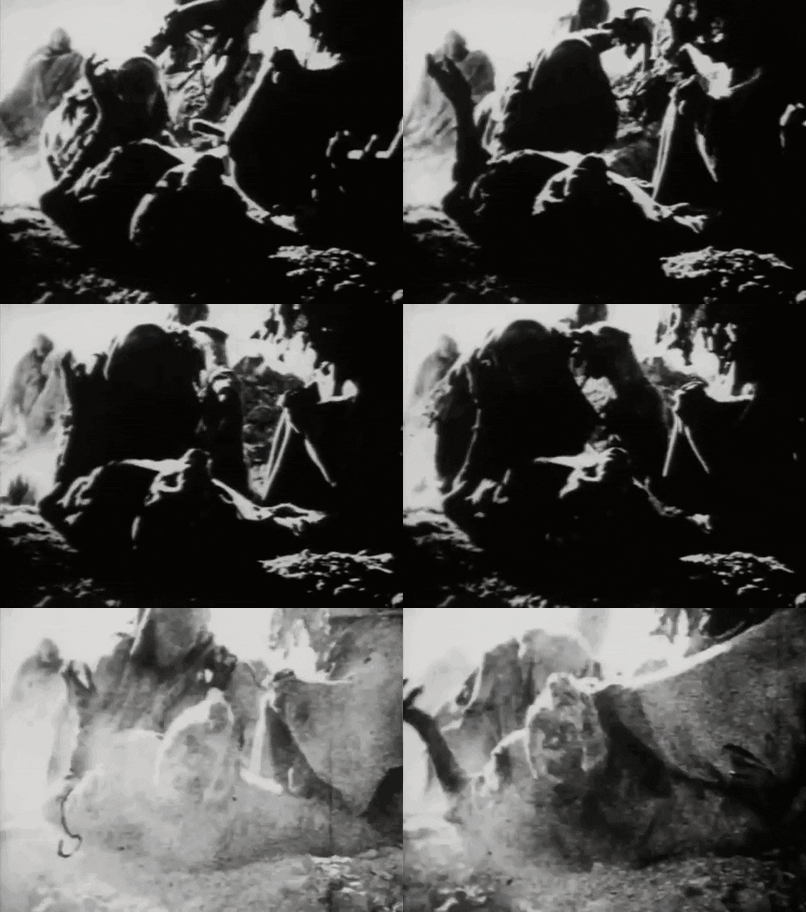
FRAGMENTS FROM A DIARY IN HELL
by Antonin Artaud (1927)
“This pain driven into me like a wedge, in the center of my purest reality, in this place of sensitivity where the two worlds of body and spirit rejoin—I have learned how to distract myself from it through the effects of a delusion.
Within this moment that lasts the duration of a lie’s creation, I create for myself a distraction, an evasion, and I lurch onto a false trail shown by my blood. I close the eyes of my intelligence and, letting the unspoken in me speak, I give myself the illusion of a system full of terms that I do not understand. But from this minute mistake I still get the feeling of having seized something real from the unknown. I believe in spontaneous conjurations. On the paths where my blood leads me, there cannot be a day that I will not discover a truth.
Paralysis overcomes me and increasingly prevents me from returning to myself. I have no touchstone, no base [...] I look for myself in places I don’t recognize. My thoughts cannot go where my emotions and the images surging in me push them. [...]

Finrod Artîwelë - Transfiguration Macabre (2024)
I am definitively beside life. My torment is as subtle and elegant as it is harsh and rough. I need immense amounts of imaginative effort, multiplied tenfold in the clinch of this suffocating asphyxiation, to even think of what hurts me. [...] These terrifying forms advancing on me—I feel as though the despair that they bring me is alive. It slips into the knot of life after which the roads to eternity open up. Truly, separation forever. The forms slide their knives into my center, where I feel like a man, they cut the vital ties that join me to my idea of a lucid reality.
Forms of a capital despair (truly vital),
a crossroad of separations,
a crossroad of the feeling in my flesh,
abandoned by my body,
abandoned by all possible sentiment in man.
I can only compare this to the state in which one finds oneself during the delirium of a fever that occurs during the course of serious illness.
Time can pass and the social convulsions of the world can ravage the thoughts of men, but I am free of any thought that dips into such phenomena. Leave me to my dim clouds, my immortal powerlessness, my unreasonable hopes. But make it known that I abdicate none of my mistakes. If I have misjudged, it is the fault of my flesh, but these lights that my mind lets filter in hour after hour, it is in my flesh where blood mixes with flashes of lightning.
I chose the kingdom of pain and of shadow like others choose that of radiance and accumulation of matter.
I do not toil in the area of any which domain.
I toil in the unparalleled duration. "
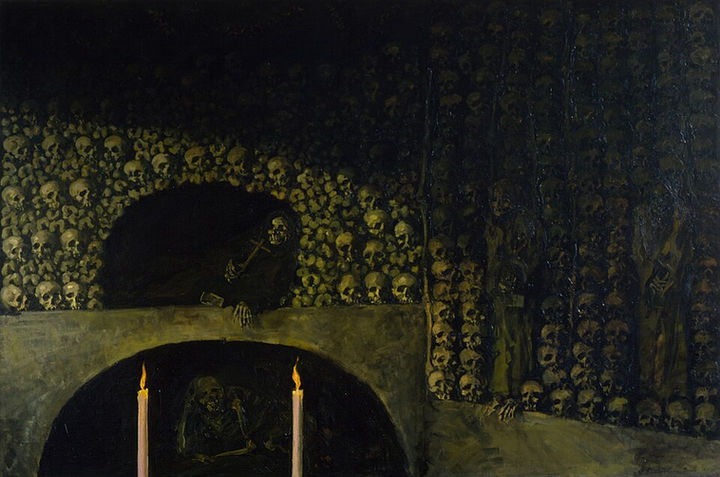
Oscar Parviainen - Crypt of the Capuchin Friars (1914)
CREDITS
Delirium Tremens basic track originally recorded on August 1st & 6th, 2014. Released as Reichsztäg 485 on Raagnarök (2014). Remixed in 2024 by Sébastien Dumontier, mastered by Laurent Roussel.
Electric guitar, bass guitar, synths, violin, vocals & Mellotron played by Finrod Artîwelë. Viola played by Dora Lussiana. Piano, organ and keyboards played by Lari Mevimann. Drums played by Lavinia Roussel.
-
The track's first section was originally composed for the final Act of the play Les Justes by Albert Camus, stage-directed by Les Justes au corps, played on the 16th, 17th, 19th and 20th october 2013.
Improvised piano variations from Part II, recorded on Halloween 2014, the day the Raagnarök album was completed.