

PANDORA'S BOX (DARK EXITS)


Félix Nadar - Les Catacombes de Paris (1861)
UNDERSTANDING THE MYTH
According to Hesiod, when Prometheus stole fire from heaven, Zeus, took vengeance by presenting Pandora to Prometheus' brother Epimetheus. Pandora opened a jar left in her care containing sickness, death and many other evils which were then released into the world. Though she hastened to close the container, only one thing was left behind ; Elpis – usually translated as Hope.
Is the hope imprisoned within a jar full of evils to be considered a benefit for humanity, or a further curse? A number of mythology textbooks echo the sentiments of M. L. West: “ [Hope's retention in the jar] is comforting, and we are to be thankful for this antidote to our present ills." Some scholars such as Mark Griffith, however, take the opposite view: “ [Hope] seems to be a blessing withheld from men so that their life should be the more dreary and depressing." The interpretation hangs on two related questions: First, how is elpis to be rendered? Second, does the jar preserve elpis for people, or keep it away from them?
Elpis can be translated in a number of ways. A number of scholars prefer the neutral translation of expectation. Classical authors use the word elpis to mean expectation of bad, as well as expectation of good. Others hold the minority view that elpis should be rendered expectation of evil (or the like).

Iulia Dima/Finrod Artîwelë - Zôhn-Ẁïrr Atvikaah (2019)
The answer to the first question largely depends on the answer to the second one: should the jar be interpreted as a prison, or a pantry? The jar certainly serves as a prison for the evils that Pandora released – they only affect humanity once outside the jar. Some have argued that logic dictates, therefore, that the jar acts as a prison for elpis as well, withholding it from the human race. If elpis means expectant hope, then the myth's tone is pessimistic: All the evils in the world were scattered from Pandora's jar, while the one potentially mitigating force, hope, remains locked securely inside. A less pessimistic interpretation understands the myth to say: countless evils fled Pandora's jar and plague human existence; the hope that humanity might be able to master these evils remains imprisoned inside the jar. Life is not hopeless, but human beings are hopelessly human.
It is also argued that hope was simply one of the evils in the jar, the false kind of hope, and was no good for humanity, since, later in the poem, Hesiod writes that hope is empty (498) and no good (500) and makes humanity lazy by taking away their industriousness, making them prone to evil.
But, if the jar is full of evils, then what is expectant hope – a blessing – doing among them? This objection leads some to render elpis as the expectation of evil, which would make the myth's tone somewhat optimistic: although mankind is troubled by all the evils in the world, at least it is spared the continual expectation of evil, which would make life unbearable.

VII OF CUPS : The Seven of Cups is where we put our hands in the fire, so to speak. It is the card of soothsayers and magic spells. A demonic alchemy floats in the air above each cup, worldly temptations in their excess : rage, greed, lust, pride, envy, gluttony and sloth.
This is unsteady ground, where we can be torn loose from moorings. Dreams and fears compete for attention equally here. It is the place where we either make a horrible, morbid bargain with the devil and lose ourselves to corruption, or we restrain our base impulses and muster self-control. It is the battleground within us where we must fight one of our hardest battles - the destruction of that part of ourselves that selfishly looks out for our own personal comforts above all else.
“There are horrors beyond life's edge that we do not suspect, and once in a while man's evil prying calls them just within our range."
― H.P. Lovecraft,
The Thing on the Doorstep (1933)

John William Waterhouse - Pandora (1896)
CREDITS
Pandora's Box originally recorded on August 12th, 2020. Released as Dark Exits on ‘Dark Exits' (2020). Remixed in 2025 by Sébastien Dumontier, mastered by Laurent Roussel.
Bowed guitars, keyboards, wind & voices played by Finrod Artîwelë.
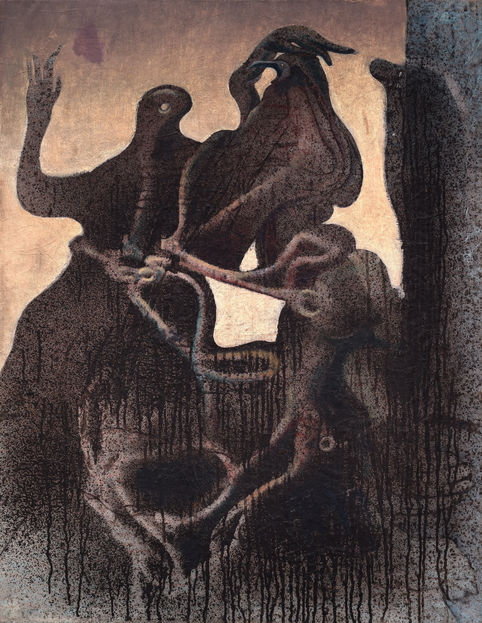
Max Ernst - Zoomorphic Couple (1933)